Austria votes in run-off between far-right and independent


AFPImage captionThe run-off between Alexander Van der Bellen, left, and Norbert Hofer, has upended Austrian politics


Austrians have begun voting in a presidential run-off poll that could elect the European Union's first far-right leader.

Norbert Hofer, of the Freedom Party, faces independent Alexander Van der Bellen, backed by the Greens.

Mr Hofer topped the first vote but fell well short of an outright majority. The run-off is expected to be close.

For the first time since World War Two, both the main centrist parties were knocked out in the first round.

The migrant crisis has become the key issue.

Ninety-thousand people claimed asylum in Austria last year, equivalent to about 1% of the Austrian population, and the Freedom Party has run a campaign against immigration.

While the presidency is a largely ceremonial post, the president has powers to dismiss the government - something Mr Hofer has already threatened to do.

And a Hofer victory could be the springboard for Freedom Party success in the next parliamentary elections, scheduled for 2018.

Despite slowdown, China’s migrants rooted in Africa


“This is my 13th year in Africa, and I will continue to pursue my career here,” says 40-year-old Jacky Huang, managing director of Good Time Steel Zambia Limited.


Mr Huang, a Chinese national, has given himself the screen name 'Seek dreams in Africa' on his WeChat account, the popular text and voice messaging service developed by China’s Tencent.

While his two sons and wife live in Canada, Mr Huang spends most of his time in Zambia. He has also worked in Algeria and Nigeria.

“As a professional manager, the most rewarding part of working in Africa is that I got the extraordinary opportunity to realise my individual value, while the most challenging part is being separated from family,” says Mr Huang.

Despite the distance from loved ones, he chooses to stay.

Many Chinese who have established themselves in Africa share this feeling. During the boom years of the commodities super-cycle and China’s rapid economic expansion, Chinese migrants travelled thousands miles to seek opportunities in Africa’s fast growing frontier economies.

Many arrived without friends or relatives, only the belief that this new place offered business opportunities. Now, despite slowing growth across emerging markets and China’s new directive to re-balance the economy towards internal demand, many intend to stay on.

Although there are no official figures available, estimates suggests that there are at least one millionChinese immigrants currently working and living in Africa.

China became Africa’s largest trading partner in 2009. Today, the continent is also the Asian giant's second largest market for overseas project contracting and fourth largest for outward investment.

For the past decade, many profit-seeking Chinese investors and companies have come to believe there is nowhere in the world to do business like Africa. This is particularly true for engineering and construction firms, which have brought over Chinese workers in droves.

Chinese firms feel their advantage in African markets is strong when compared with others, where the domestic construction industry might have strong local contractors to compete against or fewer large-scale construction projects on offer.

At Addis Ababa Bole International Airport in early February, for instance, shops were festooned with decorations and gifts for Chinese Lunar New Year. Hundreds of Chinese construction and factory workers boarded direct flights to Guangzhou and Beijing to visit family for the holiday. 

All the workers This is Africa spoke to planned to return to Africa after a week or two’s break.

Tied fortunes

As a result of these linkages, China and Africa are now closely tied economically. Shifts in one affects the other.

According to the Interational Monetary Fund, a 1 percent decrease in China’s investment growth is associated with an average 0.6 percent decrease in Africa’s export growth rate.

Due to the fluctuating yuan, lower global commodity prices, falling Chinese demand and a saturated job market compounded by overpopulation, China’s GDP expanded 6.9 percent in 2015, down from 7.3 percent in 2014. This is the slowest growth rate in 25 years.

The economic slowdown in China has also led to an 18.3 percent decline in bilateral trade with Africa, from $220bn to $170bn in 2015, according to official figures from the China State Council. Greenfield foreign direct investment into Africa fell 84 percent in the first two quarters of 2015.

The effects of a downturn in China are already impacting African countries, especially those highly dependent on natural resources. In Zambia, where the economy is highly dependent on the copper mining industry, output has fallen drastically due to a collapse in global copper prices, driven in part by lower Chinese demand for raw materials.

The copper industry has further suffered from severe national power shortages and an unpredictable mining tax regime.

Several foreign mines, including the Chinese state-owned CNMC Baluba mine, have suspended production. More than 10,000 workers have been laid off across the sector. According to Chinese Economic and Commercial Counsellor’s office in Zambia, trade between China and Zambia in 2015 decreased 38.09 percent year on year.

“The withdrawal of many Chinese investments in Africa is inevitable due to the still-weak global economy, and it is just a matter of time,” says Jinghao Lu, the project director of the Kenya-based Sino-Africa Center of Excellence Foundation (SACE).

Political and economic uncertainty are also ongoing concerns for Chinese investors. In Zambia, for example, many foreign companies are taking a wait-and-see attitude ahead of a general election scheduled for August 11, 2016.

“Two-thirds of our Chinese employees went back to China for a holiday. Our project in Zambia has shut down for half a year due to a gloomy economy in Zambia, and the government is not able to pay most fees,” a source from China State Construction Engineering, a state-owned construction conglomerate, tells This is Africa.

The company has signed several road construction deals with the government of Zambia worth in excess of $300m between 2014 and 2016.

Commitment remains

Pessimism is only partly warranted. Despite its economic slowdown, China has reaffirmed its commitment to Africa, pledging to invest $60bn across the region over the next three years during the Forum on China Africa Corporation Summit 2015.

Where China’s government leads, investors and entrepreneurs will continue to follow. In order to adapt to the changing economic context, many Chinese businesses are looking for ways to localise their businesses by investing in training locals and creating niche businesses outside the extractive sectors.

Jihai Agriculture, for instance, is focused on its ‘go local’ campaign with the aim of creating a mushroom industry in Zambia. The enterprise is co-operating with the Zambian ministry of agriculture and livestock to promote the mushroom industry, and to extend it to various provinces in Zambia through training and financial support.

Managing director of Jihai Agriculture Yunwu Yao remains optimistic about his business prospects in Zambia. Mushroom cultivation is already a flourishing industry in China. Mr Yao believes that Zambia can become the hub of mushroom production and marketing in Africa. “I believe Zambia is a peaceful and friendly country, its economy will continue to progress. I also believe agriculture is a sunrise industry and it has a promising future,” says Mr Yao.

Already, Jihai Agriculture is producing 5 tons of oyster mushrooms and king oyster mushrooms daily. Most of their output is destined for local markets, but with an eye to expanding exports to the Far East in the future.

Staying on

Mr Yao and his entrepreneurial cohort represent a new phase in Chinese migration to Africa.

According to China House, the continent’s first social enterprise focused on helping Chinese companies and individuals forge positive connections with African communities, Chinese immigrants’ interests in Africa have diversified following the main waves of the early 2000s.

Based in Nairboi, Kenya, most of China House’s members have international backgrounds and advanced degrees from top universities around the world. This is a shift from the labourers and tradesmen, often from China’s working class provinces, that characterised earlier migrant waves.

SACE, for instance, continues to bring young Chinese graduates interested in getting work experience in Africa to work with and learn from African companies. Most of its trainees speak English and try to integrate with Kenyan culture. 

According to SACE’s Mr Lu, besides work experience, many graduates who come to Kenya are interested in touring the region. Hongxiang Huang, founder of China House, believes “the new Chinese blood” will have a positive impact on future relations with African countries.

Historically, there have been some tensions between Chinese immigrants’ cultural and business practises and locals.

In Zambia, Chinese mine owners have been accused of labour rights violations in order to increase profits, causing discontent among workers. Ghana has on several occasions deported swaths of illegal Chinese miners.

In Kenya, allegations of Chinese restaurants intentionally discriminating African patrons raised questions about the growing Chinese community’s integration in Kenya.

Some of this is due to perceptions of risk. Mr Huang of China House says that Chinese employers, who play a significant role in Chinese employees’ daily lives, remain apprehensive about security threats.

“Many of them do not allow their Chinese employees to go out during evening. They do not like their employees having too many local friends as they are afraid of company information leakage, which might cause troubles,” he explains.

Though some Chinese migrants are willing to engage, learn local languages, explore rural areas other non-Africans rarely go and to engage in all forms of labour, the public perception is that on average Chinese migrants’ integration remains low.

But as Chinese immigrants become a more permanent fixture in African societies, more needs to be done to bring locals and newer arrivals together.

Hong Kong security tightened as key Chinese leader visits

EPAImage captionMore than 6,000 police have been deployed around Hong Kong, a substantial portion of its police service

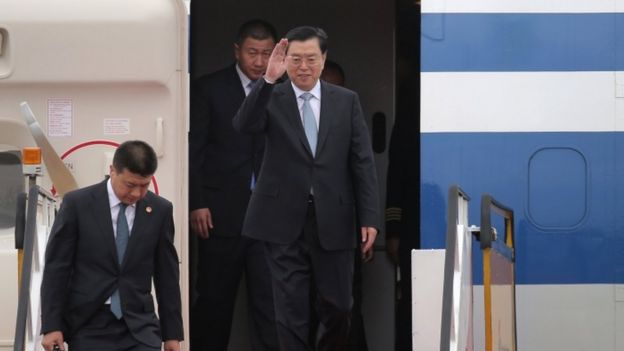
Tight security is in place in Hong Kong for the visit of the most senior official from Beijing since large pro-democracy protests in 2014.

Zhang Dejiang, the leader responsible for Hong Kong affairs, arrived amid discontent with alleged interference by Beijing.

Mr Zhang said he was in Hong Kong "to listen to all sectors of society".

More than 6,000 police have been deployed amid planned protests by pro-democracy groups.

In a five-minute speech on arrival, Mr Zhang, 69, conveyed "President Xi Jinping's warm regards and well wishes for the people of Hong Kong" and said he came "with the care of the central government and all Chinese people".

Noting his trip had "attracted wide attention", he said: "I will listen to the chief executive and the [Special Administrative Region] government regarding their work, and to all sectors of society about what recommendations and requirements they have about implementing the principles of "one country, two systems".
Who is Zhang Dejiang and what is he doing on the trip?

He heads China's Hong Kong and Macau affairs office but is also chairman of the National People's Congress Standing Committee, making him China's third-highest ranking leader after President Xi and Premier Li Keqiang.Image copyrightAPImage captionZhang Dejiang brought the "warm regards" of the president

Mr Zhang is to speak at a policy conference on President Xi's One Belt, One Road economic project that aims to improve connectivity between China and Eurasia.

He will meet a group of four pro-democracy legislators at a reception, ahead of a banquet.
Why is the trip contentious?

As head of Hong Kong affairs, Mr Zhang was responsible for a key decision in 2014 on Hong Kong's political future and is the highest-ranking mainland official to visit since then.

The mini-constitution, or Basic Law, under which Hong Kong is governed, says the ultimate aim is for the leader to be elected by universal suffrage.

Although China had promised direct elections by 2017, it said in 2014 that the leader, or chief executive, put up for election would come from a list of two or three candidates chosen by an effectively pro-Beijing nominating committee, angering pro-democracy campaigners.Image copyrightAFPImage captionA protest in September 2014, following a key political ruling

The decision led to full-scale protests, dubbed the Umbrella Movement. Tens of thousands of protesters camped in the streets for weeks but the camps were gradually dismantled with no concessions from the government.

Current Chief Executive CY Leung remains unpopular. Commentators will be watching and listening carefully to see whether Mr Zhang will hint at endorsing him for another term.
Who are the protesters and what are their concerns?

Following the 2014 protests, a number of so-called "localist" groups sprung up and showed themselves willing to use violence to battle what they see as a dilution of the city's identity, fearing growing social and political influence from mainland China.

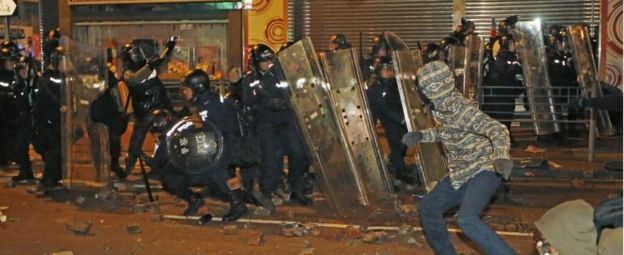
In February, hundreds of demonstrators dug up and threw bricks during a violent clash with police trying to shut a night food market. The market was seen by the protesters as a symbol of local traditions.

There have also been increasing concerns over the freedoms Hong Kong enjoys - unseen on the mainland - which were integral to the agreement that enabled Hong Kong to be returned to China by the British in 1997.Image copyrightAPImage captionRioters in Mong Kong in February lifted the lid on the so-called "localist" groups considered a more radical force in Hong Kong politics

They include freedom of speech, the press, assembly, association, travel and trade union membership.

One incident that raised particular concern was the disappearance of five Hong Kong booksellers known for publishing controversial books about Chinese leaders.

The men were later found to have been detained by mainland authorities in a move condemned by the UK.
What are the security measures for the visit?

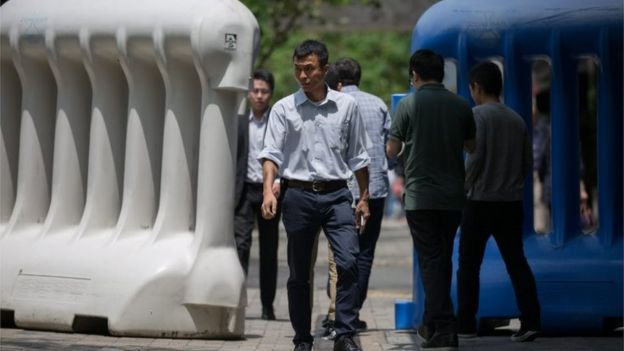
In addition to the 6,000 police officers on duty, hundreds of huge, water-filled plastic barriers have been deployed near Mr Zhang's hotel and the convention centre at which he will speak.

Demonstrators will be given designated areas and are unlikely to be visible to Mr Zhang.

Pavement stones have reportedly been glued together to prevent them from being ripped up and thrown by protesters.

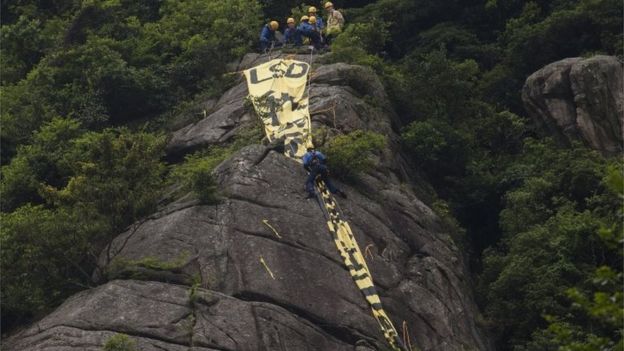
The South China Morning Post said security was tight at the airport for Mr Zhang's arrival. It said guards reportedly took away journalists' umbrellas, along with a small yellow towel used by one reporter to cover a camera lens.Image copyrightEPAImage captionA giant banner calling for universal suffrage was swiftly removed from Hong Kong's Beacon HillImage copyrightEPAImage captionWorkers in Hong Kong were seen gluing down paving stones earlier this month, with lawmakers speculating it was to secure them ahead of the visitImage copyrightEPAImage captionHuge barriers have cordoned off security zones in central Hong Kong

The colour yellow, along with umbrellas, has become a symbol of the pro-democracy movement.

Hours before Mr Zhang landed, activists unfurled a yellow banner on Hong Kong's Beacon Hill reading: "I want genuine universal suffrage". The banner was later removed.

On Monday a Hong Kong man was arrested just over the border in Shenzhen for trying to buy a drone purportedly to be used to disrupt the visit.

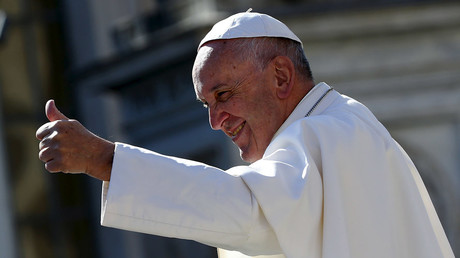
‘State must be secular, single-religion states end badly’ – Pope Francis to French Catholic paper

Pope Francis believes that a healthy secularism paired with a strong law that grants above all a religious freedom is the key to a successful and peaceful state, while states tied to a single religion don’t have a future.
“Confessional states end badly…I believe that secularism accompanied by a strong law which guarantees religious freedom provides a framework for moving forward,” the Pontiff said in an interview with Guillaume Goubert, director of French Roman Catholic newspaper La Croix.

The royal road to peace is to see others not as enemies to be opposed but as brothers and sisters to be embraced.
Addressing increasing worries of Christians that Islam is becoming ever more widespread in Europe, Pope Francis says that everyone has a right to exercise the religion he or she chooses, and a secular state as opposed to a single-religion one can grant this opportunity.
“We are all equal, as sons of God or [creations] of our personal dignity. But everyone should have the freedom to exercise their own faith. If a Muslim woman wants to wear a hijab, she should be able to. Similarly so, if a Catholic wants to wear a cross. We must have an opportunity to profess our faith not on the sidelines of the [national] culture but within it,” Francis said.
He mildly criticized France in this regard, where concerns over Islam and its confusion with extremism have been spreading exponentially following terror attacks that rocked its capital.

“The small criticism I’ll be addressing to France in this regard is that France exaggerates secularism. This stems from a way of considering religion as a subculture and not a whole culture. France should take a step forward on this issue to accept that openness to transcendence is everyone’s right.”
When asked about current controversial social issues, such as the legality of euthanasia or same-sex marriages, the Pontiff once again stated that social issues must be dealt with by secular authorities, but that people's personal beliefs and convictions should be respected when a certain law is adopted.
“It is the parliament that must discuss, argue, explain, reason. Thus the society will evolve and grow. But when the law is passed, the state must respect [religious beliefs]. In each legal structure, objections of conscience must be present for it is a human right. Including for a government official, who is also a human being,” Francis said, adding that a truly secular state cannot exist without criticism and respect for its people and their beliefs.
“The state must respect criticism. That is true secularism,” Francis said.

Armenia & Azerbaijan vow not to resort to arms in Nagorno-Karabakh

Russian Foreign Minister Sergei Lavrov (L), Armenia's President Serzh Sargsyan (2nd L), U.S. Secretary of State John Kerry (C) and President Ilham Aliyev of Azerbaijan (R) attend a meeting in Vienna, Austria, May 16, 2016. © Leonhard Foeger / Reuters
AddThis Sharing Buttons356
Leaders of Armenia and Azerbaijan supported the ceasefire in the disputed Nagorno-Karabakh region, promising to seek a non-military resolution to the heated conflict in a statement issued by the OSCE following a Minsk group meeting in Vienna on Monday.
Read moreArmenia, Azeri General Staff chiefs agreed Nagorno-Karabakh ceasefire in Moscow on April 5
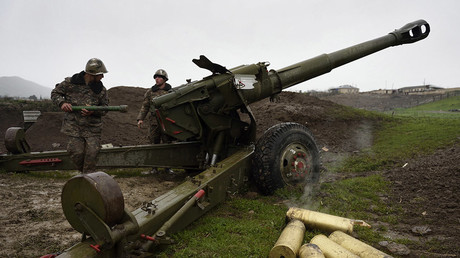
Leaders of the rival states met on the highest level for the first time since the brief escalation in the protracted territorial conflict early in April, which saw the sides attacking each other with artillery, tanks, and rockets, while accusing one another of provoking the hostilities. After three days of shellingresulting in multiple casualties and an ensuing blame game, a Russia-brokered ceasefire was enacted following a meeting between the countries’ chiefs of staff in Moscow on April 5.
Armenian President Serzh Sargsyan and Azeri President Ilham Aliyev agreed in Vienna to adhere to the original provisional ceasefire agreement that was brokered to terminate the increasingly violent ethnic conflict of 1994-1995. Hostilities between ethnic Armenians living in Azerbaijan’s enclave of Nagorno-Karabakh and the central Azeri government erupted in the late 1980s.
“They reiterated that there can be no military solution to the conflict. The Co-Chairs insisted on the importance of respecting the 1994 and 1995 ceasefire agreements,” reads the OSCE statement, referring to the position of the meeting’s co-chairs – Russian Foreign Minister Sergey Lavrov, US State Secretary John Kerry, and State Secretary for European Affairs of France Harlem Desir – with regard to the flared-up conflict in the border area.
Sargsyan and Aliyev also expressed their readiness to further “reduce the risk of violence” in the area by establishing a new OSCE mechanism that would thoroughly investigate all incidents occurring along the contact line of the Nagorno-Karabakh conflict zone and provide for an exchange of data on missing persons under the aegis of the Red Cross.
Commenting on the feasibility of finding a peaceful resolution to the Nagorno-Karabakh conflict, Lavrov stressed at a press-conference on Monday that there was room for compromise between the previously warring parties.Russian Foreign Minister Sergei Lavrov (L), Armenia's President Serzh Sargsyan (2nd L), U.S. Secretary of State John Kerry (C) and President Ilham Aliyev of Azerbaijan (R) attend a meeting in Vienna, Austria, May 16, 2016. © Leonhard Foeger

“At least, if there was no such a possibility, then Russia, the USm and France would stop engaging in it [peace talks],” he said, as cited by TASS.  Lavrov emphasized that the mediators’ aim is to end the conflict altogether, saying that the ultimate goal is to “start moving forward to the full settlement of the conflict.” 
However, taking into account the existing tension between the sides, international negotiators will have to employ a gradual approach, Lavrov stressed.
It was agreed that the next meeting between Sargsyan and Aliyev, which is expected to pave the way for a final settlement of the dispute, is to be held at a yet unknown location in June.
As the conflict came to the boiling point earlier in April, Armenia said it would recognize Nagorno-Karabakh’s independence if Baku continued to shell the breakaway Republic, vowing to “continue to fully carry out its obligations in providing security for the population in Nagorno-Karabakh,” while looking into the possibility of “working on a military cooperation treaty with Karabakh.” 
Azerbaijan submitted pleas to the UN, NATO and the EU in response, demanding that Yerevan “free all occupied territories, and provide complete territorial integrity and sovereignty of the Republic of Azerbaijan, recognized on international level.” 

    3 injured as Turkish football fans set fire to own stadium after bitter home loss (VIDEO)


    Three people were injured in Turkey after Eskisehirspor football fans trashed their own stadium and set it on fire following a 2-1 defeat to Medipol Basaksehir. Luckily, the team is set to move to a newly built stadium next season.
    As the final whistle blew, disappointed supporters began to slowly and sorrowfully destroy the stadium, tearing out seats, setting bleachers and billboards on fire, and throwing them down onto the pitch.


    Running onto the green, the fans overturned the goals in a demonstration of disgust for their team, which had just been defeated 2-1 in its last home match of the Turkish Super Lig by the Medipol Basaksehir football club.
    According to local media, the 1953-built stadium was ruthlessly vandalized because the building is set to be demolished to make way for an urban park at the end of this season anyway. Eskisehirspor will play at a newly constructed 33,000-seat stadium next season.

    The teenager who sparked an internet scandal By Will SmaleBusiness reporter, BBC News


    JAMES DREW

    The Boss
    The rise of popular lesbian dating app Her
    The man who bet his house on his invention
    Sisters open romance-only bookshop
    The filmmaker who swapped communism for Hollywood

    Ted Nash realised that his gossip website had somewhat backfired when a media scrum descended upon his parents' home in rural south-west England.

    Aged 19 at the time back in late 2010, and still living with his mum and dad in Somerset, Mr Nash had developed a website called Little Gossip, where schoolchildren could anonymously post news of interest to their fellow pupils.

    Mr Nash, now 25, says he had the best of intentions, but things very quickly went wrong.

    The website was an immediate viral hit, gaining 33,000 users in just its first hour, then hundreds of thousands across the length and breadth of the UK within a few days.

    Unfortunately, at least 10% of the comments posted were malicious. And amid accusations that it was a bullying free-for-all, schools and parents were soon loudly complaining.

    And Mr Nash was doorstepped by tabloid reporters and TV crews.Image captionThe woes at Little Gossip were widely reported
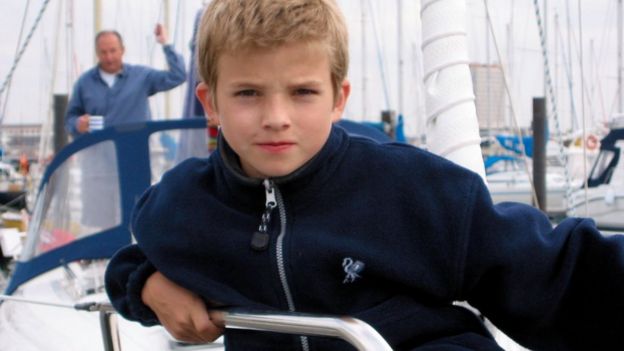
    Mr Nash says: "My mum walked out one morning in her dressing gown to open the front gate for someone, and suddenly there were reporters asking her, 'Does Ted Nash live here?'

    "She ran back inside, shouting to me, 'What have you done?'"

    With the story being widely reported across national UK newspapers, and on TV, Mr Nash shut down the website a few months later.

    A serial technology entrepreneur, who set up his first money-making website when he was just 12 years old, Mr Nash describes Little Gossip as "an unbelievable learning curve".

    He says: "As is more often the case, I came up with the idea for the website to solve my own problems.

    "At school I was always much more interested in building a company. Because of that I felt that I had missed out on a huge amount of gossip and socialising, so I thought something like Little Gossip would be very useful, and it was started with good intentions.

    "Unfortunately it was a sad state of affairs that you couldn't allow some people to be anonymous [without them abusing it], and we had to close it."
    'Spark'

    Now chief executive of a start-up technology company called Tapdaq, which aims to help small mobile phone apps more easily grow user numbers, Mr Nash is already 13 years into a busy and eventful business career.

    At 17 he made almost £3m when three million people around the world paid 99 cents to download an app he had developed called Face Rate, and then he subsequently spent 18 months helping Rupert Murdoch's UK newspaper group, News UK, develop its mobile presence.Image copyrightTED NASHImage captionMr Nash says he was 12 when he caught the business bug

    But Mr Nash says it all started when, aged 12, and on a family holiday in Spain, he was inspired by an 18-year-old he met who had made a decent amount of money by developing an early internet search engine.

    "I saw all the material items that he had, and me being 12 I wanted that as well.

    "It completely set off a spark in my head, and from that point onwards I was just fascinated by technology and the impact it can have. And, of course, the money it can make.

    "At that age all I could think about was buying the next toy - literally. But [as] you get older you realise that the money is not so important, and that it is a subset for building something of value for other people to use."

    Returning to the UK, Mr Nash set to work on learning how to build websites, and still just 12, was successful with one of the first ones he built. Called Rediz, it was an online shopping index, with links to shopping websites.Image copyrightJAMES DREWImage captionTapdaq is based in London

    Mr Nash was savvy enough to build up a user base, and he was soon getting paid by retailers for each customer who clicked through to their websites from his.

    "I was earning the kind of money that 12-year-olds shouldn't, but I had to get my parents to sign all my contracts, because I was obviously too young."

    Many of Mr Nash's other websites, including an attempt at a search engine, were far less successful.

    He says: "From age 12 to 16, it was pretty much all trial and error. I built [metaphorically speaking] thousands of websites, the majority of which didn't see the light of day."

    Support, advice and occasional investment along the way came from Steve Pankhurst, the founder of one-time UK social networking website Friends Reunited. Mr Nash had met Mr Pankhurst via his father.
    'Billion dollar'

    After Rediz, Mr Nash's next big hit was Face Rate, an app that measured - or at least tried to measure - how attractive a user was. It went viral, and Mr Nash says he "made an obscene amount of money for a kid of that age".Image copyrightTAPDAQImage captionMr Nash has big ambitions for Tapdaq

    The ignominy of Little Gossip then followed, before Mr Nash helped the Times and Sunday Times newspapers improve their digital presence.

    Mr Nash says his sole attention since 2013 has been London-based Tapdaq, which helps mobile phone apps cross-advertise on each other's platforms, thereby helping them to more easily build up user numbers. He says it has so far secured financial backing of $8m (£5.5m).

    The ambitious Mr Nash has high hopes for the company, which he says "could become a multibillion-dollar business".

    "For me being an entrepreneur is both a blessing and a curse," he says. "I'm always thinking [of business ideas]. It keeps me awake at night."
    Copyright © maandamano
    Designed by Siyamdezign | Edited By Madamvia
    Your Link | Your Link | Your Link
    Powered By Blogger
    Back to Top